Business Magazine Cover : Create Free Business Magazine Covers in Minutes with AI
Create Custom Business Magazine Covers Quickly with Pixazo Best AI Business Magazine Cover Maker. Try for Free!
Get Started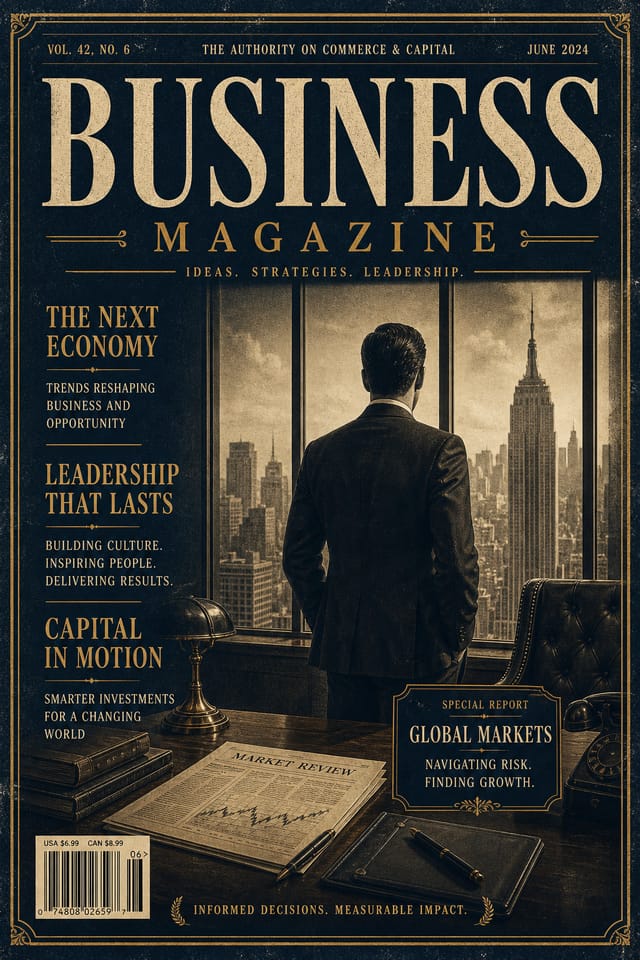




Design Intelligence for Business Magazine-Covers: A Technical Perspective
The Business Magazine-Cover Design Framework
Not all magazine-cover design styles work the same way.
Business design has specific characteristics that distinguish it from other approaches: particular color affinities, compositional tendencies, and typographic conventions that trained designers recognize immediately.
Pixazo applies this style knowledge automatically.
When you request a business magazine-cover, the AI pulls from a visual vocabulary appropriate to business design, producing output that reads correctly to anyone familiar with the style.
Core of Business Magazine-Cover AI: A Closer Look
Compositional Structure
Layout and hierarchy decisions reflect business design patterns. The proportions and arrangement match how business designs are conventionally structured.
Fast Generation
Complete business magazine-cover designs generate in seconds. No rendering queues, no waiting for batch processing.
Text Placement Options
Describe where you want text elements positioned in your business magazine-cover. The AI follows compositional direction about headline placement and body copy layout.
Prompt Refinement
Adjust your description to refine any aspect of the business magazine-cover design. The AI responds to specific direction about colors, layout, or content.
Consistency Across Variants
Generate multiple business magazine-covers for a project and maintain visual consistency across the set. Specify your core design parameters and vary secondary elements.
Context-Aware Design
Describe your business magazine-cover's purpose and audience. The AI adjusts visual weight, complexity, and clarity based on the intended use context.
The Reach of Business Magazine-Covers: A Practical Guide
Recruitment and Hiring Outreach
Generate business magazine-covers for job fairs, career pages, and employer branding initiatives. Designs that represent company culture visually.
Internal Communications
Create business magazine-covers for all-hands meetings, policy announcements, and employee recognition programs. Professional materials for internal audiences.
Product Launch Campaigns
Design business magazine-covers for new product introductions across digital and print channels. Materials that establish positioning from day one.
Client and Investor Presentations
Design business magazine-covers that support pitch decks, quarterly reviews, and stakeholder updates. Visual summaries that communicate key metrics.
Business Magazine-Cover Capabilities: By the Numbers
Getting More from Business Magazine-Cover AI: Practical Guidance
Check Alignment Carefully
Misaligned elements are one of the most common signs of amateur business magazine-cover design. Use grid lines and snap-to features to keep things precise.
Consider the Context
Think about where your business magazine-cover will appear. A design optimized for social media needs different proportions and density than one for a physical bulletin board.
Keep Typography Simple
Use no more than two typefaces per business magazine-cover. One for headlines, one for body text. Consistency in typography signals professionalism.
Iterate with Variations
Generate 3-5 versions of your business magazine-cover before committing. Comparing variations side by side often reveals the strongest direction.
Build a Business Magazine-Cover: In Minutes
Draft the Concept
Start with a text description of your business magazine-cover concept. Specify the visual style, colors, layout direction, and key text. Detailed prompts produce more accurate business magazine-cover designs than general ones.
Verify the Design
The AI produces a business magazine-cover based on your description. If the first result isn't exactly right, adjust the prompt to address what needs changing. Most designs reach the target within a few iterations.
Wrap the Project
Download your completed business magazine-cover in the format that fits your use case. High-resolution files for print, web-optimized versions for digital, or PDF for production-ready delivery.
Watch: Creating Business Magazine Cover designs step by step
How Business Style Varies: What Works Best
Editorial Business
Text-dominant business magazine-cover layout inspired by print publication design. Typographic variety creates visual rhythm.
Geometric Business
Structured business composition using grid systems and angular forms. Order and precision define the visual approach.
Textured Business
Business design with added surface depth. Background treatments add visual interest without disrupting legibility.
High-Contrast Business
Bold business visual treatment with strong tonal contrast. Elements read clearly at any viewing distance.
Classic Business
Traditional business design principles applied to modern magazine-cover format. Clean composition, conventional hierarchy, time-tested visual decisions.
Showcasing Business Magazine-Covers: Community Creations
Real creators sharing their business designs made with Pixazo AI.

Contemporary business style magazine-cover, grid-based structure, disciplined spacing, restrained decoration, readable at viewing distance
Business magazine-cover for outdoor billboard at 14x48 feet, extreme readability at distance, three-word headline max, high contrast background
Full-bleed background business magazine-cover, image or texture extends to edges, foreground elements float above, headline anchored to centerCopy-Paste Business Magazine-Cover Prompts That Work
Copy any prompt below and paste it into Pixazo to generate your design instantly.
Full-bleed business magazine-cover, background treatment extends to edges, foreground elements positioned for compositional balance, strong central hierarchyBusiness aesthetic magazine-cover, palette drawn from business design tradition, layout proportions consistent with business conventions, purposeful use of each elementLarge-format business magazine-cover design, elements sized for visibility at print scale, no fine detail that would be lost in productionBusiness magazine-cover with strong visual hierarchy, largest element reads clearly, supporting elements organized by importance, clean background treatmentMonochromatic business magazine-cover, single-hue palette with value variation for contrast, typographic hierarchy creates visual interest without color complexityHigh-impact business magazine-cover, immediate visual read at thumbnail size, clear headline dominance, supporting information structured logicallyBusiness Magazine-Cover Export Guide: Choosing the Right Format
Print-ready format for business magazine-cover files that preserves fonts, colors, and layout across different devices and print services.
JPG
Compressed image format suited for business magazine-cover designs with photographic elements where smaller file size matters more than pixel-perfect edges.
SVG
Scalable format for business magazine-cover designs that need to render crisply at any resolution, commonly used for web and responsive layouts.
WEBP
Modern web format offering smaller file sizes than PNG or JPG for business magazine-cover images without significant quality loss.
PNG
Lossless image format ideal for business magazine-cover designs with transparency, sharp text, and web display at predictable file sizes.
Business Magazine-Cover AI: What You Should Know
You can generate as many variations as your account tier allows. Refine your prompt with each iteration to move toward your target design. Most users find the right direction within three to five generations.
Generate your initial business magazine-cover, review the output, then modify your prompt to adjust specific elements. Each regeneration produces a fresh design incorporating your changes. Most users reach their final business magazine-cover design within two to four iterations.
Brand kits let you save your logo, fonts, and color palette so every business magazine-cover you generate stays on brand. Once configured, the AI applies your brand parameters automatically alongside business style conventions.
The AI renders text as specified in your prompt, so double-check spelling and punctuation before generating. If text renders incorrectly in a business magazine-cover, adjust your prompt and regenerate. The AI follows your exact text input.
Longer, more detailed prompts generally produce more accurate results for business magazine-cover design. Include all the relevant information: style direction, color preferences, content to display, intended use, and any specific design elements you want. There is no strict character limit.
Where Business Magazine-Cover AI: Capabilities and Caveats
Known limitations and trade-offs of AI-generated business design. Every AI design tool has boundaries. Knowing these limits before you start helps you get the most out of business magazine-cover generation.

