10 Best AI 2D Image to 3D Model Converter Tools in 2026

The demand for 3D modeling is soaring across industries like gaming, animation, interior design, and 3D printing, fueled by advancements in artificial intelligence. AI-powered 2D to 3D image converter tools are transforming how creators turn flat images into immersive 3D models, making complex workflows accessible to everyone from professionals to beginners.
This blog explores the best 10 AI 2D to 3D image converter tools of 2026, including Pixazo, Artificial Studio, Alpha 3D, and more. We will dive into their features, usability, and applications to help you choose the perfect tool for your creative needs. These innovative solutions are revolutionizing digital design, empowering users to craft stunning 3D assets with ease and precision.
Suggested Read: Best AI 3D Model Generators in 2026
What Are AI 2D to 3D Image Converter Tools?
AI 2D to 3D image converter tools use artificial intelligence to transform two-dimensional images into three-dimensional models by analyzing depth, textures, and shapes. These tools simplify the traditionally complex process of 3D modeling, making it accessible to users without advanced technical skills and converting an image to 3D model.
Key Benefits
- Streamlined Workflows: Automates model creation, reducing manual effort and time.
- Accessibility: Enables beginners and professionals alike to produce 3D assets.
- Versatility: Supports applications in gaming, virtual reality (VR), augmented reality (AR), 3D printing, and product design.
Applications
- Gaming and Animation: Create characters, environments, and assets for games and films.
- VR and AR: Develop immersive experiences for platforms like Meta Quest and Apple Vision Pro.
- 3D Printing and Design: Generate printable models for prototypes, decor, or manufacturing.
- Marketing: Produce 3D visuals for e-commerce and promotional campaigns.
Suggested Read: 10 Best AI 3D Model Generator Tools in 2026
How We Select the Best AI Design Generator Platforms at Pixazo
At Pixazo, we carefully evaluate AI design generator platforms to help users skip the overwhelming trial-and-error process. Our experts, with extensive experience in AI-powered design tools, assess each platform based on creativity, ease of use, customization options, and overall performance. We put these tools to the test by creating designs across different categories to ensure they deliver high-quality results effortlessly. Every recommendation is based on thorough research and real-world testing, with no paid placements or outside influence. Want to know how we pick the best AI design platforms? Explore our detailed evaluation process.
Disclaimer - Portions of this article were drafted with AI and reviewed by Jayesh Chaubey
The Best AI 2D to 3D Image Converter Tools
The rapid evolution of AI 3D Model Generator tools and platforms has transformed 2D to 3D image conversion, enabling creators to generate high-quality 3D models with unprecedented ease and speed. Below, we explore the top 10 AI-powered tools for 2026, each offering unique features tailored to diverse industries like gaming, AR/VR, 3D printing, and marketing. From beginner-friendly platforms to professional-grade solutions, these tools are redefining creative workflows.
1. Pixazo 2D to 3D Image Converter
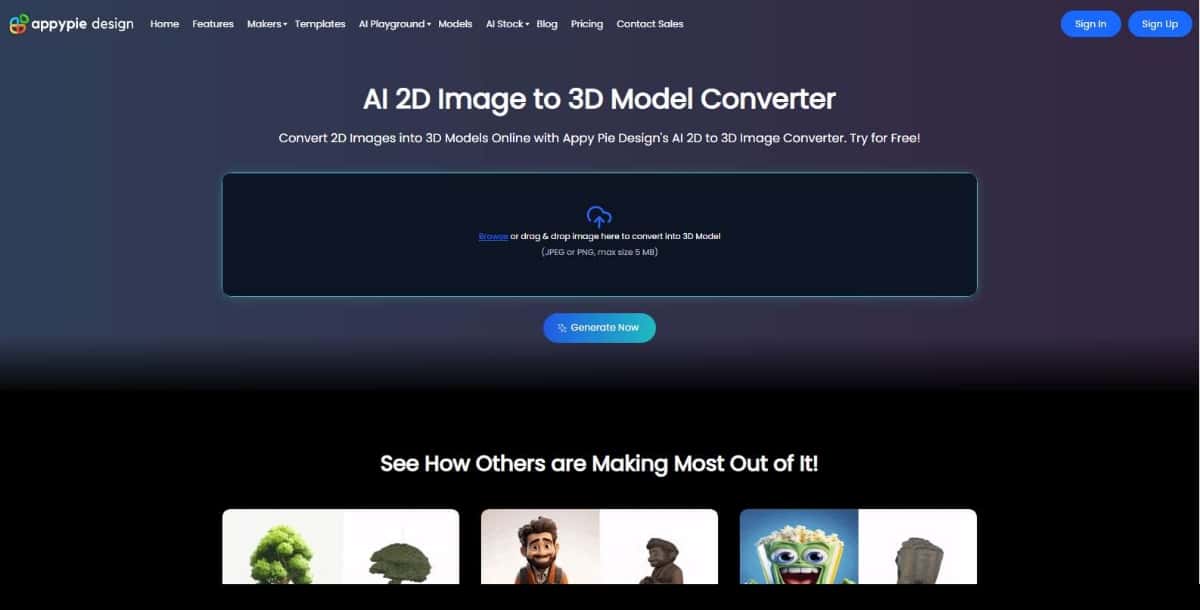
Overview: Pixazo is a versatile, cloud-based platform that leverages AI to convert 2D images into 3D models, making it a go-to choice for small businesses, marketers, and non-designers. Its intuitive interface prioritizes simplicity without sacrificing functionality, catering to users who need quick 3D assets for e-commerce or promotional campaigns.
Key Features:
- AI Image to 3D Precision: Convert your images into 3d models instantly and effortlessly.
- Drag-and-Drop Interface: Allows users to upload images and generate 3D models with minimal effort.
- Multi-Format Support: Exports models in GLB, OBJ, and even MP4 for animated previews.
- Background Removal: Automatically isolates objects for cleaner 3D renders.
- Real-Time Previews: View and tweak models before finalizing exports.
Performance Insights: Pixazo excels in speed, generating basic 3D models in under a minute for simple images (e.g., product photos). Its AI algorithms are optimized for objects with clear edges, such as furniture or gadgets, but may struggle with complex scenes or low-resolution inputs.
Use Case Example: A small online retailer uploads a 2D image of a coffee mug, removes the background, and generates 3D models for an interactive product page, enhancing customer engagement.
Pros:
- Beginner-friendly with a shallow learning curve.
- Fast processing for quick turnarounds.
- Affordable for small businesses.
Cons:
- Limited advanced editing tools, restricting professional-grade refinements.
- Output quality varies with input image resolution.
Best For: Small businesses, e-commerce vendors, and marketers needing rapid 3D visuals for websites or ads.
Pricing: Freemium model with basic features free; subscription plans for advanced features.
User Feedback: Users praise its simplicity and integration with other Pixazo tools, though some note the need for higher-quality outputs for professional use.
2. Artificial Studio
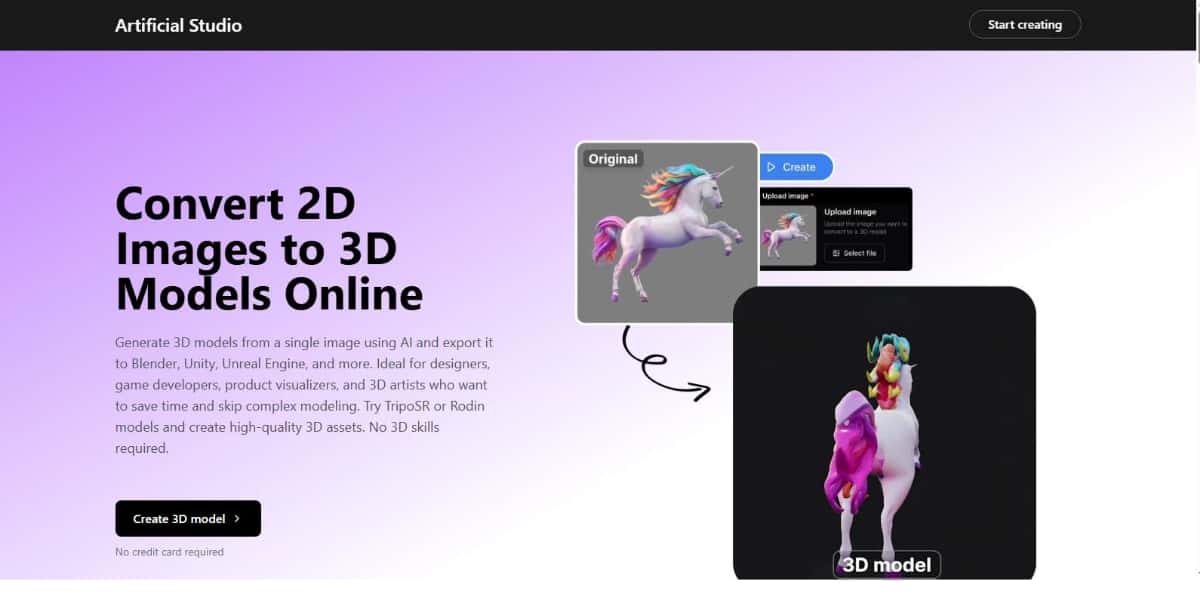
Overview: Artificial Studio is a powerhouse for professional 3D model creation, offering tools like Rodin, InstantMesh, and TripoSR to convert 2D images into high-fidelity 3D assets. Designed for game developers and animators, it balances speed and quality, making it ideal for complex projects.
Key Features:
- Rodin for Rapid Prototyping: Generates avatars and objects from single images.
- InstantMesh and TripoSR: Produce detailed meshes in seconds, suitable for gaming pipelines.
- Blender Integration: Seamlessly exports models for further editing in professional software.
- Texture Mapping: Automatically applies realistic textures based on input images.
- Batch Processing: Supports multiple image uploads for high-volume projects.
Performance Insights: Artificial Studio’s AI can generate a detailed 3D model of a character from a single portrait in 10-15 seconds, with mesh quality rivaling manual modeling. Its strength lies in handling intricate details like clothing folds or facial features, though it may require post-processing for AAA game standards.
Bringing 2D concepts to life in 3D has never been easier thanks to AI technology. Whether for e-commerce, gaming, or AR/VR projects, automated PNG to 3D conversion tools can make a big difference. Here's a look at the best AI PNG to 3D Converter tools that can speed up your workflow and deliver high-quality results.
Use Case Example: A game studio uploads concept art of a sci-fi weapon, uses InstantMesh to create a 3D model, and refines it in Blender for Unity integration.
Pros:
- Exceptional output quality for professional use.
- Fast processing for iterative workflows.
- Robust integration with industry-standard tools.
Cons:
- Steeper learning curve for non-technical users.
- Premium features require paid plans.
Best For: Game developers, animators, and studios needing high-quality 3D assets.
Pricing: Freemium with limited free credits; paid plans for advanced features.
User Feedback: Professionals appreciate the speed and quality, but beginners may find the interface overwhelming without tutorials.
3. Alpha 3D
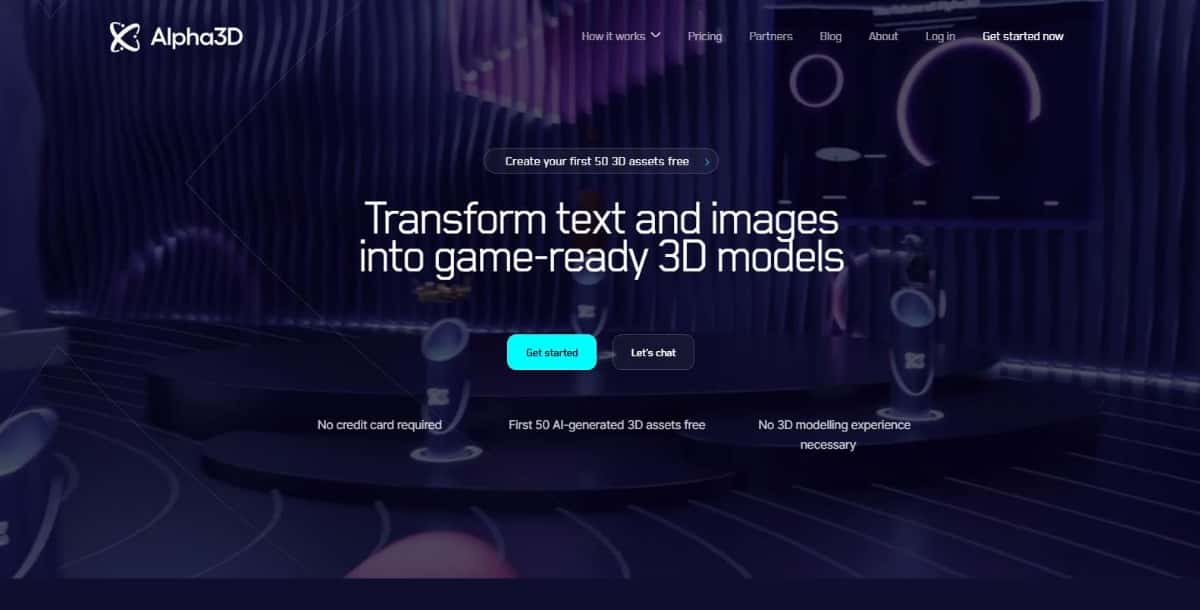
Overview: Alpha 3D is a generative AI platform focused on creating AR/VR-compatible 3D models from 2D images. Its accessibility makes it a favorite for hobbyists and AR/VR developers looking to prototype immersive experiences.
Key Features:
- Simple Interface: Designed for users with minimal 3D modeling experience.
- AR/VR Optimization: Exports models compatible with Meta Quest and Apple Vision Pro.
- Text-to-3D Support: Combines image-based conversion with text prompts for hybrid modeling.
- Cloud-Based Processing: No need for high-end hardware.
- Preview Mode: Test models in virtual environments before exporting.
Performance Insights: Alpha 3D generates AR-ready models in 1-2 minutes, with smooth performance on XR devices. It excels with single-object images (e.g., furniture, accessories) but may produce less accurate results for crowded scenes.
Use Case Example: An AR developer uploads a 2D sketch of a virtual lamp, generates a 3D model, and tests it in a Meta Quest app for a home decor project.
Pros:
- Highly accessible for beginners.
- Strong AR/VR compatibility.
- Free tier suitable for small projects.
Cons:
- Limited customization options for advanced users.
- Occasional artifacts in complex models.
Best For: AR/VR developers, hobbyists, and educators experimenting with 3D content.
Pricing: Free with basic features; subscription plans for higher quotas.
User Feedback: Users value its AR/VR focus but request more editing tools for fine-tuning.
4. Immersity AI

Overview: Immersity AI specializes in converting 2D images and videos into immersive 3D experiences, with robust support for XR platforms. Its advanced depth mapping makes it a top choice for creators in media and entertainment.
Key Features:
- Depth Mapping: Creates multi-layered 3D models for enhanced realism.
- Apple Music Album Motion: Exports 3D visuals for music album promotions.
- XR Compatibility: Optimized for Apple Vision Pro and Meta Quest.
- Video-to-3D: Converts short video clips into 3D animations.
- Editing Suite: Adjust depth, lighting, and textures post-conversion.
Performance Insights: Immersity AI delivers photorealistic 3D models in 2-3 minutes, with exceptional depth accuracy for portraits or landscapes. Its video-to-3D feature is unique but requires high-quality input for optimal results.
Use Case Example: A music producer uploads a 2D album cover, converts it into a 3D animation, and exports it for Apple Music’s motion feature.
Pros:
- Superior depth and realism.
- Strong XR and media integration.
- Versatile for images and videos.
Cons:
- Subscription-only model in 2026.
- High-quality inputs needed for best results.
Best For: Media creators, music producers, and XR developers.
Pricing: Free (100 credits); paid plans ($5-$10 for additional credits).
User Feedback: Creators love the XR output but note the credit-based system can be restrictive.
5. Dzine
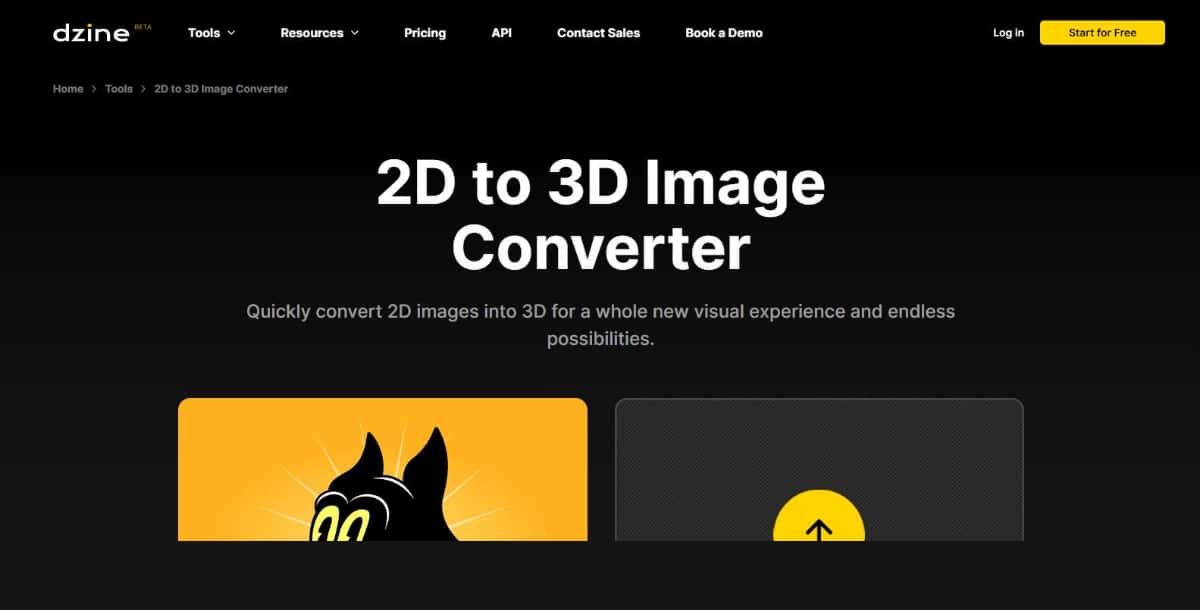
Overview: Dzine (formerly Stylar AI) is a creative AI platform that converts 2D images into stylized 3D models, offering extensive customization for designers and marketers.
Key Features:
- Style Library: Apply diverse 3D styles (e.g., cartoon, realistic, sci-fi).
- High-Resolution Exports: Up to 4K textures for professional use.
- XR Support: Compatible with Meta Quest and Apple Vision Pro.
- Fast Rendering: Models generated in under a minute.
- Batch Conversion: Process multiple images simultaneously.
Performance Insights: Dzine’s style versatility shines, producing models with distinct aesthetics in 30-60 seconds. It’s ideal for creative projects but may require manual tweaks for technical accuracy.
Use Case Example: A marketer uploads a 2D logo, applies a neon 3D style, and uses the model in an AR advertising campaign.
Pros:
- Rich style options for creative flexibility.
- User-friendly for designers.
- High-resolution outputs.
Cons:
- Free trial has export limitations.
- Learning curve for style customization.
Best For: Designers, marketers, and AR content creators.
Pricing: Free; paid plans ($8.99-$59.99/month).
User Feedback: Users enjoy the creative freedom but suggest more free-tier features.
6. Meshy
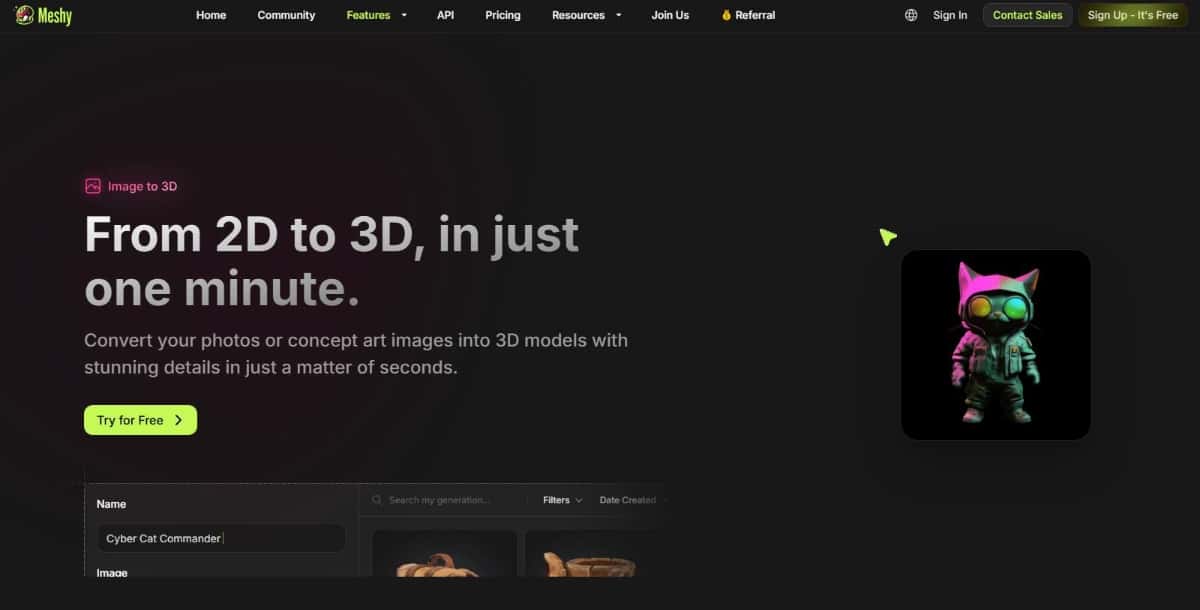
Overview: Meshy is a fast and versatile AI toolbox for 3D asset creation from images or text, popular among game developers and concept artists.
Key Features:
- Dual Input Modes: Supports image-to-3D and text-to-3D.
- Format Variety: Exports in FBX, OBJ, STL, GLTF, and more.
- Speed: Generates models in under 15 minutes.
- Texture Refinement: AI-enhanced texture mapping for realism.
- API Access: Integrates with custom workflows.
Performance Insights: Meshy produces game-ready models in 5-10 minutes, with decent mesh quality for prototyping. Complex models may need cleanup in external software.
Use Case Example: A concept artist uploads a 2D creature sketch, generates a 3D model, and uses it for a game pitch.
Pros:
- Fast and versatile for prototyping.
- Broad format support.
- Free tier for small projects.
Cons:
- Models may require post-processing.
- Limited free credits.
Best For: Game developers, concept artists, and prototypers.
Pricing: Free (200 credits/month); paid plans available.
User Feedback: Artists appreciate the speed but request more free credits for testing.
7. Banger Show
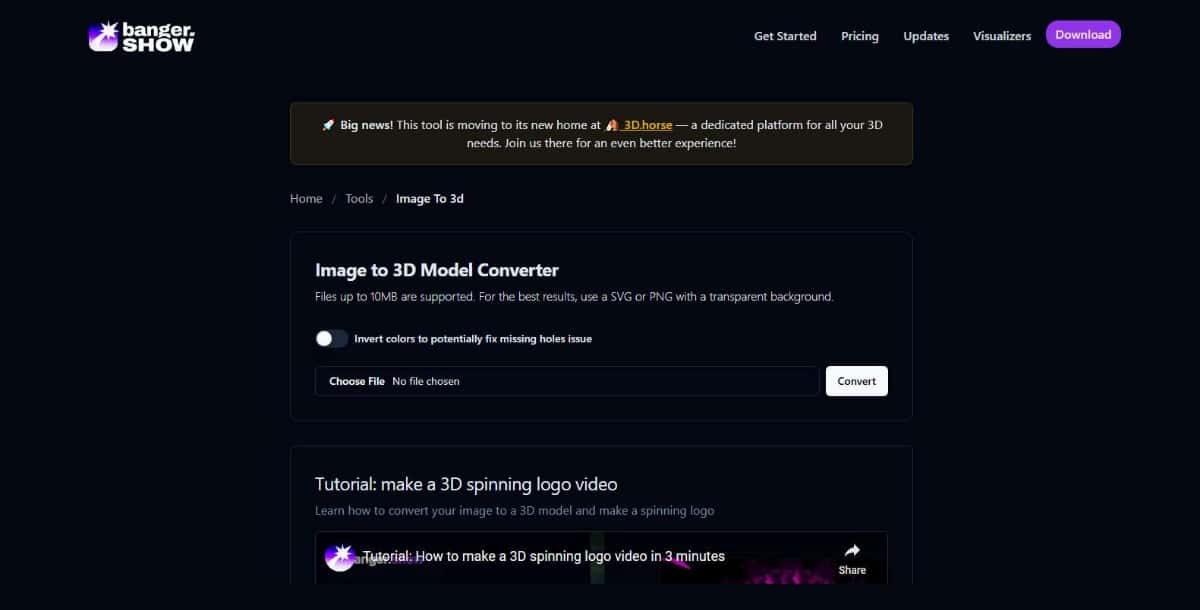
Overview: Banger Show is an emerging tool for creating animated 3D models from 2D images, designed for social media and entertainment content creators.
Key Features:
- AI-Driven Animation: Adds motion to 3D models automatically.
- Social Media Integration: Direct exports to platforms like Instagram and TikTok.
- Effects and Filters: Customizable visual effects for engaging content.
- Cloud-Based: No software installation required.
- Template Library: Pre-built animations for quick results.
Performance Insights: Banger Show generates animated 3D models in 1-2 minutes, optimized for short-form video formats. Its animations are smooth but limited to stylized aesthetics.
Use Case Example: A TikTok creator uploads a 2D character image, adds a dance animation, and shares the 3D video directly to the platform.
Pros:
- Ideal for social media content.
- Easy animation tools.
- Beginner-friendly.
Cons:
- Limited advanced features.
- Sparse documentation on compatibility.
Best For: Social media influencers and short-form video creators.
Pricing: Likely freemium; details not widely available.
User Feedback: Creators enjoy the animation ease but seek clearer pricing details.
8. Morflax Studio
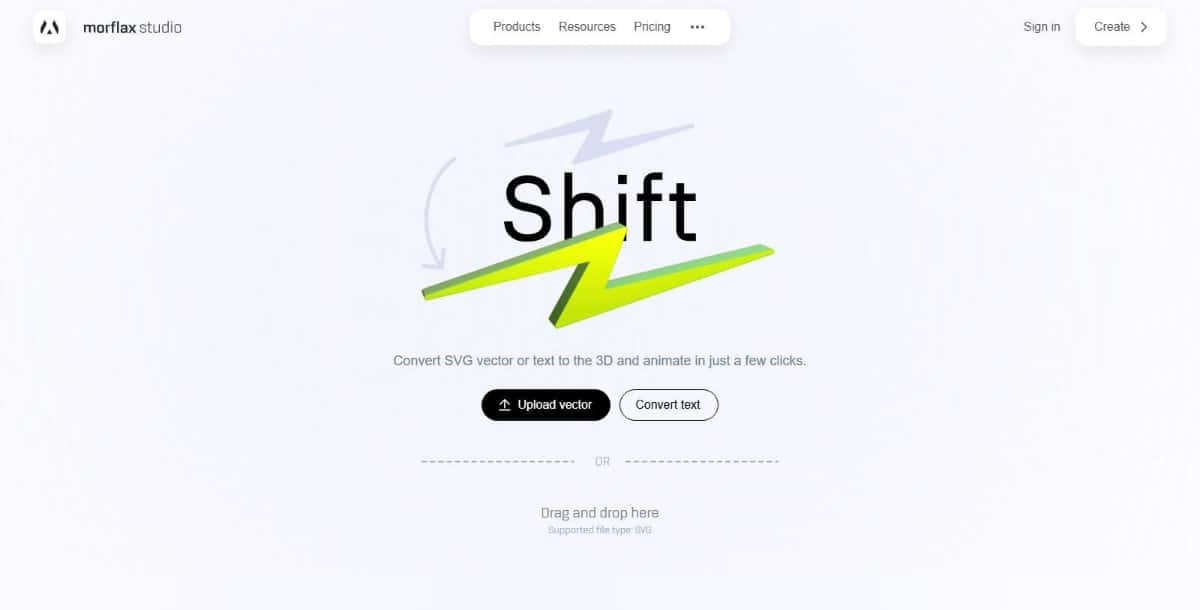
Overview: Morflax Studio is a browser-based tool that converts 2D designs (SVG or text) into animated 3D assets, perfect for branding and low-poly mockups.
Key Features:
- SVG Conversion: Turns vector graphics into 3D models.
- Animated Templates: Pre-designed animations for icons and mockups.
- Browser-Based: Accessible on any device with a modern browser.
- Customization: Adjust colors, angles, and animations.
- Export Options: Supports GLB and MP4 for versatile use.
Performance Insights: Morflax Studio creates simple 3D models in seconds, excelling with vector inputs but less suited for photorealistic needs.
Use Case Example: A startup uploads an SVG logo, converts it into a 3D animated mockup, and uses it for a pitch deck.
Pros:
- Extremely beginner-friendly.
- Fast for low-poly designs.
- No software installation needed.
Cons:
- Limited to simpler 3D objects.
- Fewer features for complex projects.
Best For: Indie developers, startups, and branding designers.
Pricing: Free with premium options.
User Feedback: Users love the simplicity but request more template variety.
9. ImagetoSTL
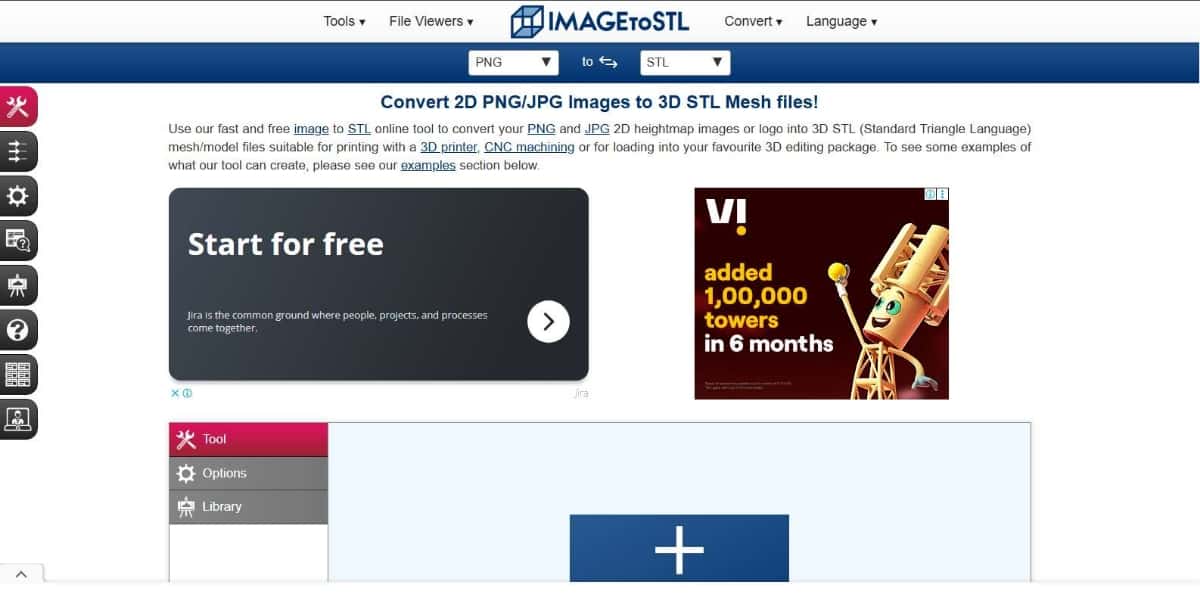
Overview: ImagetoSTL is a niche tool for converting 2D images into STL files optimized for 3D printing, catering to hobbyists and DIY enthusiasts.
Key Features:
- Pixel Tessellation: Translates grayscale images into detailed STL models.
- Simple Interface: Upload and convert with one click.
- Grayscale Support: Uses image brightness for depth mapping.
- Free Access: No account required for basic use.
- Lightweight: Processes images up to 10 MB.
Performance Insights: ImagetoSTL generates printable STL files in under a minute, with accurate depth for grayscale inputs. Color images require pre-processing.
Use Case Example: A hobbyist uploads a grayscale topographic map, converts it to an STL file, and prints a 3D terrain model.
Pros:
- Free and straightforward.
- Focused on 3D printing needs.
- Fast processing.
Cons:
- Limited to grayscale images.
- 10 MB size cap restricts inputs.
Best For: 3D printing enthusiasts and hobbyists.
Pricing: Free.
User Feedback: Printers appreciate the simplicity but suggest support for color images.
10. 3D for Print
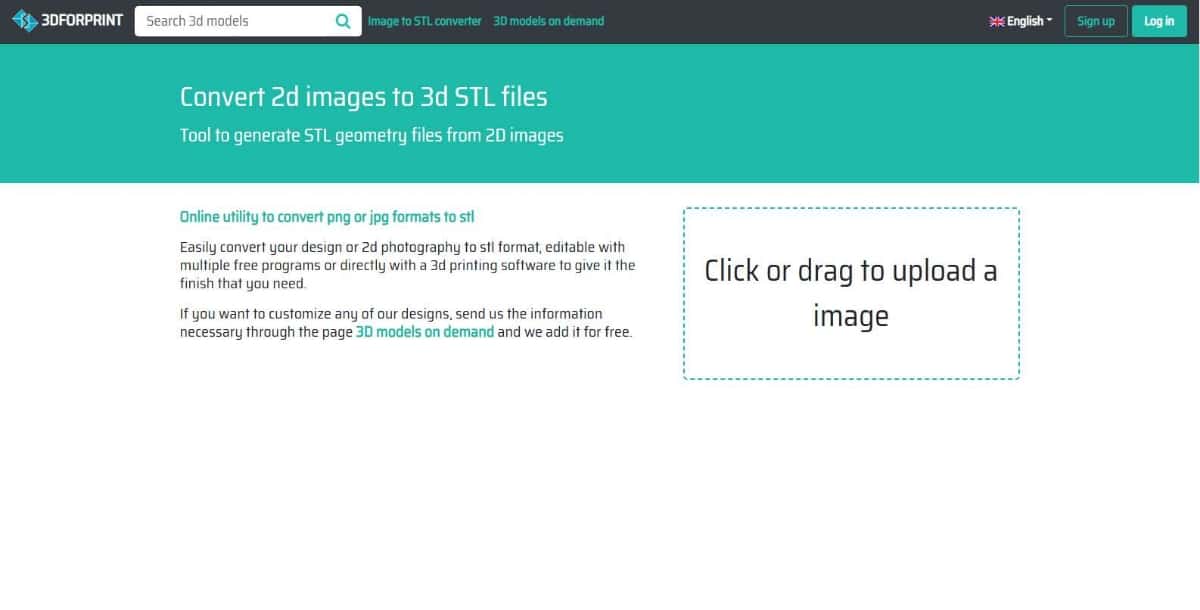
Overview: 3D for Print is an AI-driven tool focused on creating precise 3D printable models from 2D images, emphasizing accuracy for physical outputs.
Key Features:
- High-Accuracy Models: Optimized for 3D printing precision.
- STL Support: Exports files compatible with most printers.
- Depth Mapping: AI-enhanced for detailed surface textures.
- Error Checking: Detects non-manifold geometry before export.
- Cloud Processing: Handles large files efficiently.
Performance Insights: 3D for Print delivers print-ready models in 2-3 minutes, with superior mesh integrity compared to generalist tools. It’s less versatile for non-printing applications.
Use Case Example: A designer uploads a 2D image of a custom keychain, generates an STL file, and prints it for a client.
Pros:
- High precision for printing.
- Reliable mesh quality.
- User-friendly for printers.
Cons:
- Limited to 3D printing use cases.
- Pricing details unclear
Best For: 3D printing professionals and hobbyists.
Pricing: Likely freemium; specific details not widely available.
User Feedback: Printers value the accuracy but seek clearer pricing transparency.
| Tool Name | Ease of Use | Output Quality | Supported Formats | Speed | Pricing | Best Use Case |
|---|---|---|---|---|---|---|
| Pixazo | Beginner-friendly | Medium | GLB, OBJ, MP4 | ~10 Seconds | Freemium | E-commerce, marketing visuals |
| Artificial Studio | Intermediate | High | FBX, OBJ, GLTF, STL | 10-15 seconds | Freemium (app.artificialstudio.ai) | Gaming, animation |
| Alpha 3D | Beginner-friendly | Medium | GLB, OBJ | 1-2 minutes | Free & subscription-based | AR/VR prototyping |
| Immersity AI | Intermediate | High | GLB, MP4, proprietary XR | 2-3 minutes | Free (100 credits), $5-$10/credits | XR media, music album visuals |
| Dzine | Beginner-friendly | Medium-High | GLB, OBJ, FBX | 30-60 seconds | Free, $8.99-$59.99/month | Creative design, AR marketing |
| Meshy | Intermediate | Medium-High | FBX, OBJ, STL, GLTF | <15 minutes | Free (200 credits), paid plans | Game development, prototyping |
| Banger Show | Beginner-friendly | Medium | MP4, GLB | 1-2 minutes | Likely freemium (details unclear) | Social media content |
| Morflax Studio | Beginner-friendly | Low-Medium | GLB, MP4 | Seconds | Free with premium options | Branding, low-poly mockups |
| ImagetoSTL | Beginner-friendly | Medium | STL | <1 minute | Free | 3D printing |
| 3D for Print | Beginner-friendly | Medium-High | STL, OBJ | 2-3 minutes | Likely freemium (details unclear) | 3D printing |
Suggested Read: Best Closed Source 3D Model Generation APIs in 2026
How to Choose the Best Tool for Your Needs
Selecting the right AI 2D to 3D image converter tool in 2026 depends on your project goals, skill level, budget, and workflow. This section outlines key factors, practical tips, and emerging trends to help you choose from tools like Pixazo, Artificial Studio, Alpha 3D, Immersity AI, Dzine, Meshy, Banger Show, Morflax Studio, ImagetoSTL, and 3D for Print.
Factors to Consider
Evaluate these aspects to find the best tool for your needs:
1. Project Goals
- Gaming/Animation: Artificial Studio and Meshy offer high-quality outputs for game-ready assets (FBX, OBJ, GLTF).
- AR/VR: Alpha 3D, Immersity AI, and Dzine support Meta Quest and Apple Vision Pro for immersive projects.
- 3D Printing: ImagetoSTL and 3D for Print generate precise STL files for physical models.
- Marketing/Social Media: Pixazo, Dzine, and Banger Show create quick, visually appealing 3D assets or animations.
- Branding: Morflax Studio excels in low-poly mockups from SVG or text inputs.
2. Skill Level
- Beginners: Pixazo, Alpha 3D, Morflax Studio, ImagetoSTL, and 3D for Print have intuitive interfaces.
- Intermediate/Advanced: Artificial Studio, Meshy, and Immersity AI offer advanced features for users with a 3D experience.
3. Budget
- Free: ImagetoSTL is fully free; Pixazo, Alpha 3D, Morflax Studio, and Meshy offer free tiers.
- Freemium: Artificial Studio, Banger Show, and 3D for Print have paid upgrades.
- Subscription: Dzine ($8.99-$59.99/month) and Immersity AI ($5-$10/credits) suit frequent users.
4. Compatibility
- Software: Artificial Studio and Meshy integrate with Blender and Unity (FBX, OBJ, GLTF).
- XR Devices: Immersity AI, Alpha 3D, and Dzine support AR/VR platforms.
- 3D Printing: ImagetoSTL and 3D for Print ensure print-ready STL files.
- Browser-Based: Morflax Studio and Pixazo need no installation.
Also Read: Best Open Source 3D Model Generation APIs in 2026
Conclusion
AI 2D to 3D image converter tools have revolutionized digital creation in 2026, making 3D modeling accessible, efficient, and versatile across industries like gaming, AR/VR, 3D printing, and marketing. From Pixazo’s beginner-friendly interface to Artificial Studio’s professional-grade outputs, the 10 tools reviewed—Alpha 3D, Immersity AI, Dzine, Meshy, Banger Show, Morflax Studio, ImagetoSTL, and 3D for Print—offer solutions for diverse needs and skill levels. These tools empower creators to transform flat images into immersive 3D assets, streamlining workflows and unlocking new possibilities.
Related Articles
- How AI 3D Model Generators are Helpful in the Gaming Industry
- Exploring the Art and Technology Behind Tree 3D Models: A Comprehensive Guide
- How to Create Roblox 3D Models with Pixazo: A Step-by-Step Guide
- Best AI 3D Model Generators in 2026: An Ultimate Guide
- From Text to 3D: The New Frontier in 3D Modeling with AI
Most Popular Posts
- Best AI Image and Video Generators in 2026
- Best AI 3D Model Generators in 2026
- Best AI Image Generation Models in 2026
- Best AI Video Generation Models in 2026
- Best Open Source Image Generation Models in 2026
- Best Open Source Video Generation Models in 2026
- Best Prompts to Create Amazing Videos using AI